
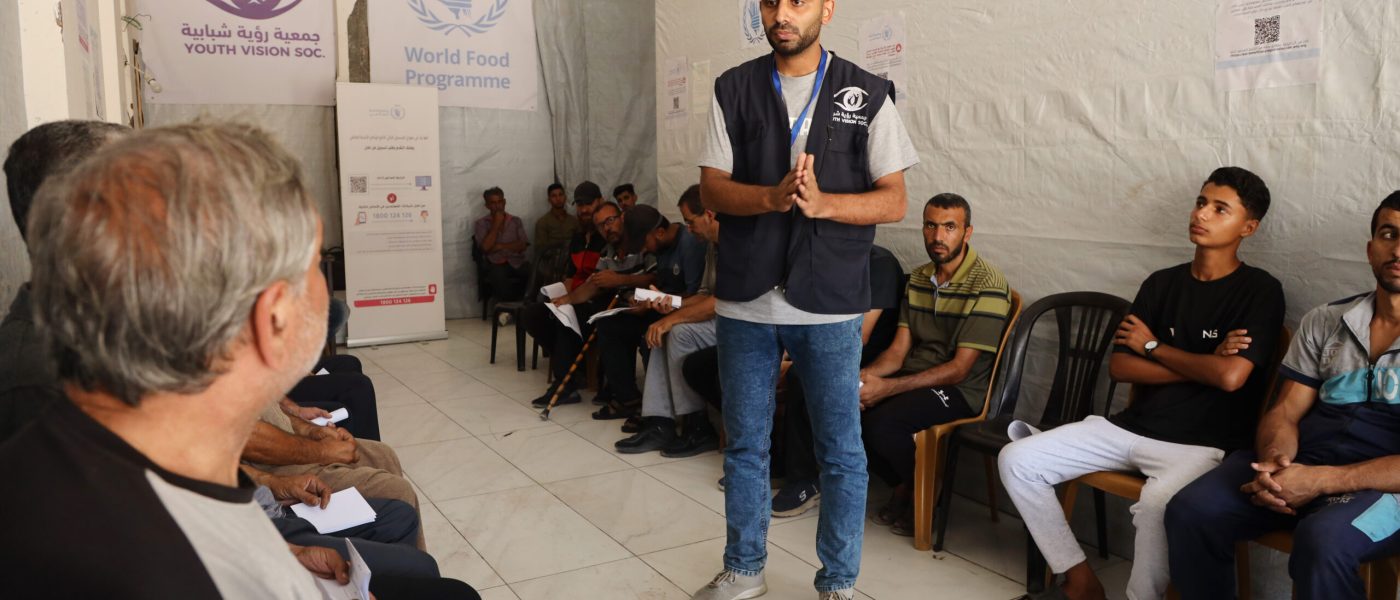
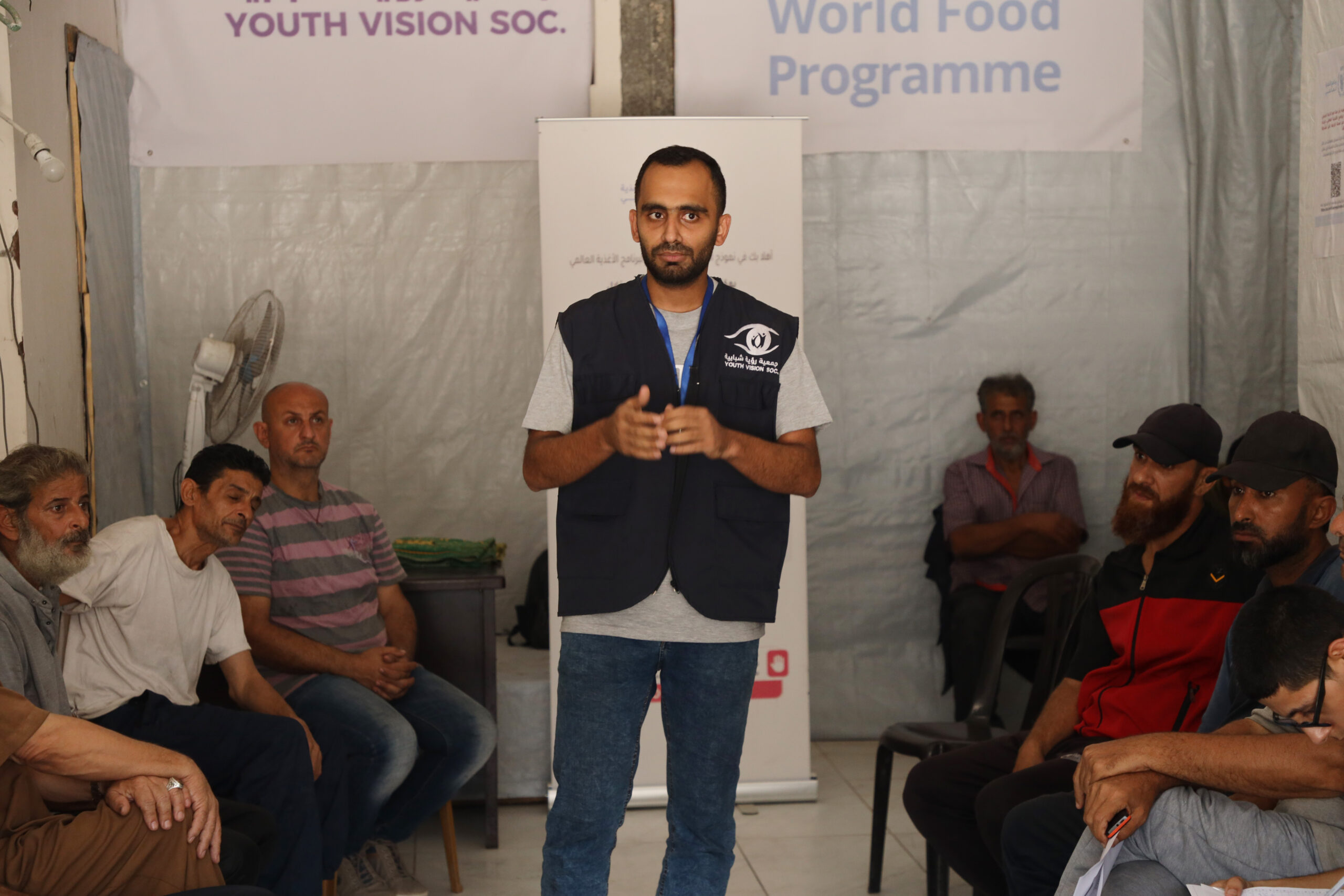
Youth vision society organized two awareness sessions at the association’s distribution point in the northern Al-Rimal neighborhood of Gaza City on Wednesday and Thursday, July 16 and 17, 2025, as part of the “In-Kind Food Assistance for Vulnerable Families” project implemented by the association in partnership with the World Food Programme.
These activities are part of the association’s ongoing efforts to promote the principles of community participation and accountability, apply standards of transparency and inclusiveness, and raise awareness in the community about how to benefit from the World Food Programme and the importance of trucks reaching distribution centers in light of the current crisis and the difficult conditions faced by the population in Gaza City.
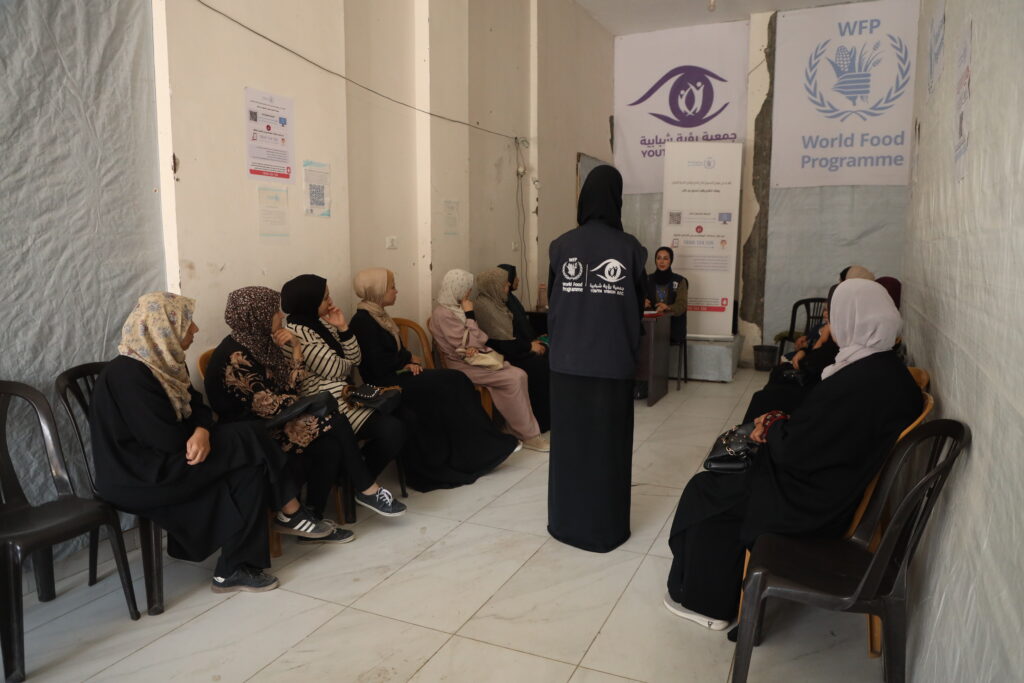

The two sessions, one for men and the other for women, targeted a number of residents of the neighborhood adjacent to the distribution point. Thirty-five men participated, ranging in age from 20 to 65, There were 29 female participants, ranging in age from 25 to 75. The two sessions were organized separately in accordance with gender equality standards and to ensure equal access for all groups and respect for the dignity of beneficiaries.
The session aimed to strengthen communication bridges between the local community and the World Food Programme through several key tools, the most important of which are: the assistance office, the helpline, community outreach and social inclusion specialists, and awareness sessions, which serve as a direct channel of communication for exchanging views, discussing queries, and addressing any challenges beneficiaries face in the field during both the registration and distribution processes.
The session addressed the following topics: an introduction to the Ru’ya Association and its activities, an explanation of the distribution criteria for beneficiaries, and an introduction to the help desk and its role as a link between the public and the World Food Programme.
During the awareness session, beneficiary Um Muhammad, 54, praised the team’s keenness to deliver aid with dignity and respect, taking into account humanitarian and social aspects during the distribution process, saying: “During the distribution process, I noticed the positive attitude of the staff at the distribution point and that there was no long wait, as it took between 5-7 minutes to receive the food parcel.”
Participant Abu Khalid, 58, called for the formation of a local committee at the distribution point to follow up on cases and conduct field visits to verify the cases received and the possibility of adding beneficiaries (such as humanitarian cases) in urgent need of food aid, saying, “We need to form a committee here that visits people and verifies the complaints they submit, and this committee submits a report on the cases in need for discussion of their eligibility.”
In turn, session moderator Wissam Al-Suwairki explained to participant Abu Khalid that beneficiaries are selected according to precise criteria and policies approved by the World Food Programme, and that there are committees affiliated with the programme that are responsible for follow-up and evaluation and work continuously to verify cases.
He also pointed out that there are internal follow-up committees affiliated with the Ruya Association that play a complementary role in this regard, noting that the public can go to the association’s assistance office, which in turn communicates with the project coordinator and the relevant committees to raise complaints and follow up on inquiries to ensure that assistance reaches those who are entitled to it.
Another participant (Lamia, 42) expressed her dissatisfaction at not having received a food parcel for a long time, questioning the mechanism and criteria for benefiting from the World Food Programme (I have not benefited from the programme before, and I have no idea how they select people. I see many of my neighbors in the building receiving it, but I don’t get anything,” she said.
At the end of the session, Lamia was referred to the assistance office of the Ruya Association to formally register her complaint. The role of the office in receiving and following up on cases, especially those related to not benefiting from aid or inquiring about eligibility criteria, was explained. The office is one of the basic tools for ensuring transparency and fairness in the provision of humanitarian services.
Other participants raised further questions about the proposed solutions to the current crisis and the failure of food aid to reach distribution points, and whether there were any solutions on the horizon to address this problem fundamentally.
At the end of the two sessions, participants expressed their appreciation for this initiative and stressed the importance of its regular continuation, given its significant impact on strengthening communication between beneficiaries, implementing agencies, and donors, raising awareness among citizens, enabling them to follow the latest developments related to the aid distribution mechanism from accurate and official sources, and ensuring that aid reaches those most in need.