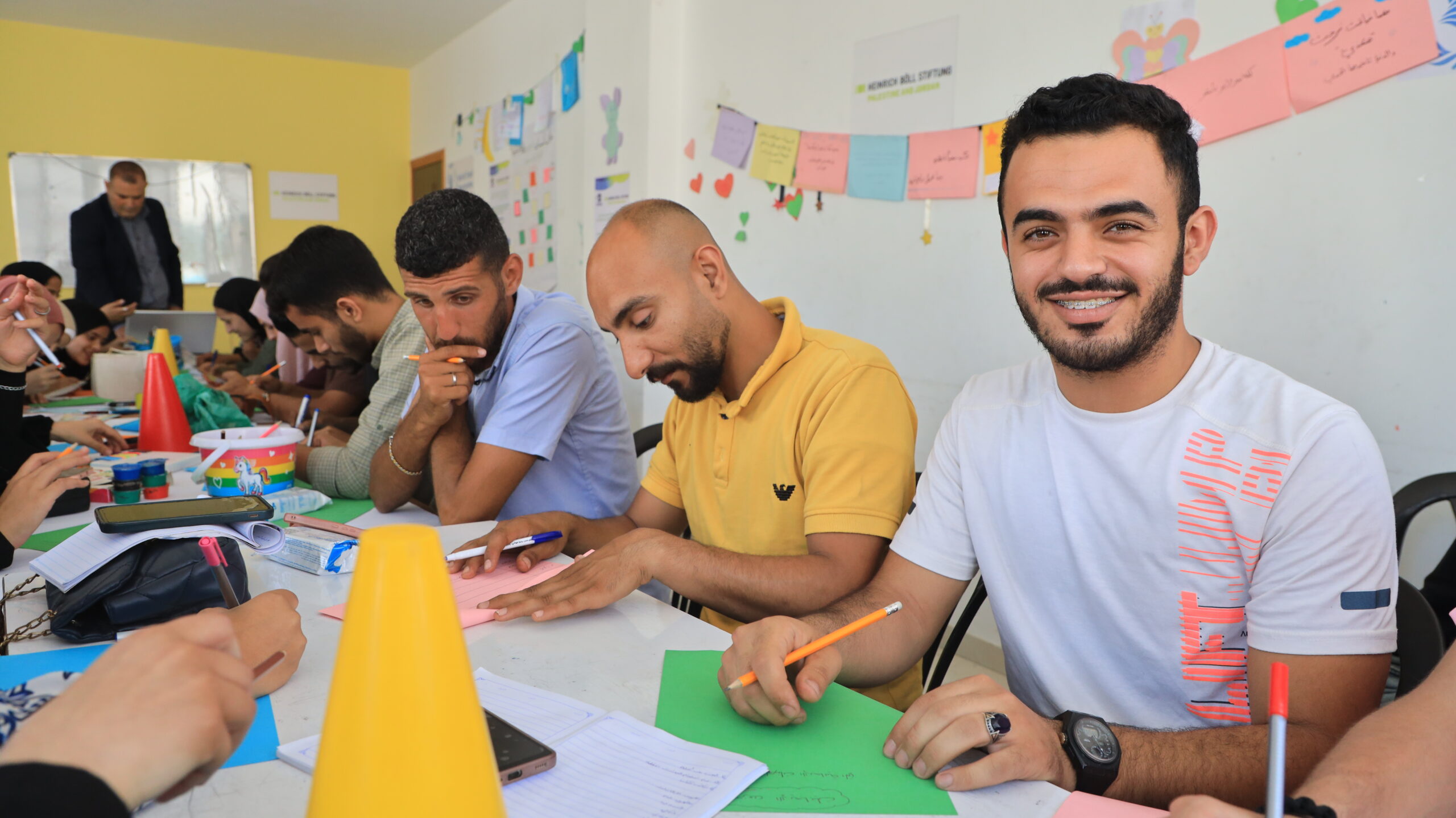
In light of the devastating effects of war on Gaza’s people and land, the Youth Vision Association, with support from the Heinrich Böll Foundation’s Palestine and Jordan office, launched a project entitled (Strengthening Youth Resilience and Inspiring Change through Psychological Support and Youth-Led Community Initiatives) with the aim of supporting young people who face enormous psychological pressure, insecurity, and uncertainty about the future.
Project coordinator Abeer Karaja explains that the project is a realistic response to the suffering of young people and is designed to directly address their psychological and social needs through psychological and social support sessions, as well as specific training that will enable them to later create and implement community initiatives led by themselves.
The first phase of the project included 64 psychological and social support sessions distributed among four youth groups, with each group receiving 16 interactive sessions led by mental health specialists, including Dr. Khawla Al-Wahidi and Dr. Mohamed Al-Masri, who contributed their expertise to strengthen the psychological and cognitive aspects of the participants and help them rebuild themselves after what they had experienced in terms of loss, anxiety, and pain.
Dr. Khawla Al-Wahidi recounts the beginnings of the meetings: (The young people described themselves with words such as ‘broken’, ‘lost’ and ‘without a future’. However, as the sessions progressed, a quiet and positive transformation began to emerge, and we started to hear new expressions such as ‘I will go back to school’, ‘I will overcome my grief’, and ‘I will start a small project to create my own opportunities).
AlWahidi recalls a moving story about one of the participants, an engineering student who lost his home and several family members during the war, which led him to drop out of school and suffer a mental breakdown. However, after participating in the sessions, he returned to school and is now continuing his studies with the same passion he had before the war.
For his part, Dr. Mohamed Al-Masri emphasized that the goal of the project was not to provide direct psychological treatment, but rather to support the gradual recovery process and create safe spaces for the internal reconstruction of each participant. He added that (healing from trauma is not achieved only with the passage of time, but through self-awareness and sincere interaction with pain,) stressing that young people in Gaza need not only someone to listen to them, but also someone who believes in them and gives them confidence that their feelings are understood in an illogical reality.
Al Masri pointed out that the young people participating in the training moved from the reception stage to action by designing and implementing community initiatives that reflect the needs of their local communities and translate what they learned in the sessions into concrete action plans. These initiatives provided real training in leadership and teamwork in the face of complex living challenges.
A number of participants expressed the impact of the project on their lives, including Kamal Ayad, a 23 years old engineering student, who said, (I used to be a closed person, but now I am able to stand in front of an audience and perform a play. I used to be nervous, but now I think calmly before acting).
Halima Kali, 19, who was prevented from attending university due to the war, said, (The project restored my hope and passion. I learned from the experiences of others and overcame my fear of facing an audience. Today, I strongly aspire to return to school).
Israa Othman, 22 years old an English literature student, recounts her experience, saying, (I was a girl who tended to isolate myself, but this project changed my view of myself and gave me back my zest for life. It helped me overcome the psychological and physical effects of displacement) She continues with a smile full of optimism (I now feel that I am regaining myself)
In an environment burdened with pain like Gaza, psychological support becomes an act of resistance, and every initiative led by young people becomes a step on the road to collective recovery. The project has proven that hope is not a luxury but an existential necessity, and that resilience is not limited to rebuilding walls but also includes restoring souls.