
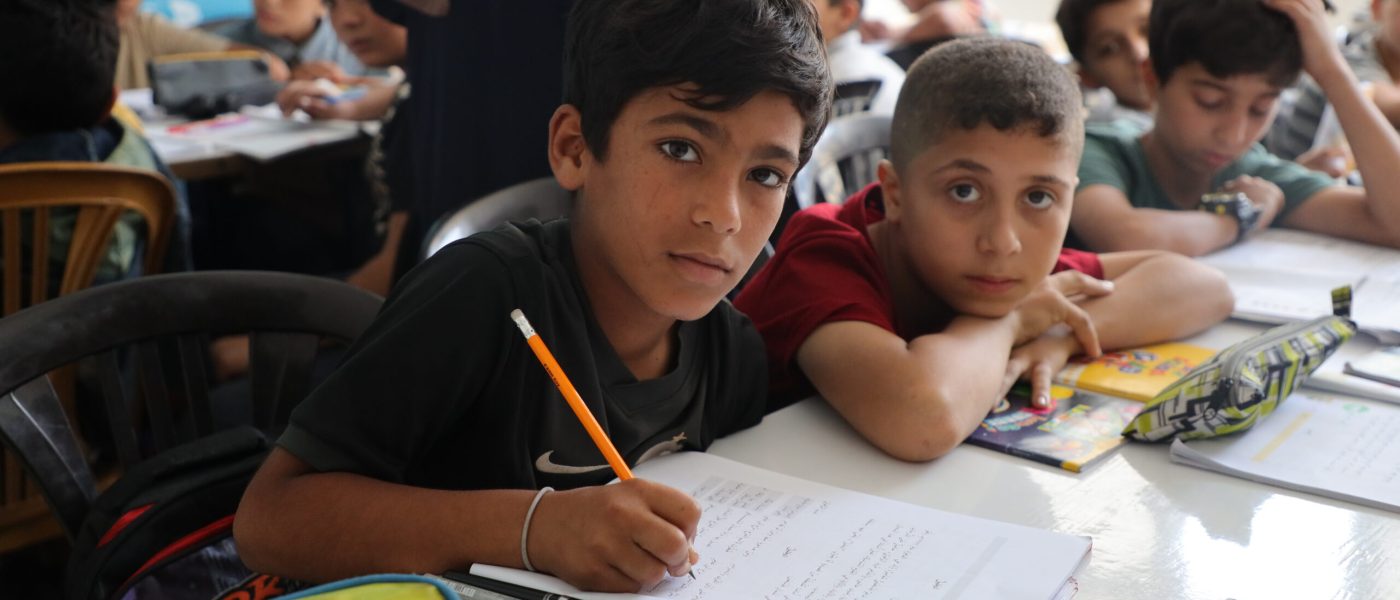
In a city where the sounds of shelling never cease and where the war has left no corner untouched by destruction, schools have been transformed from centers of learning into shelters for thousands of displaced people or rubble that is useless for anything else.
Nevertheless, in the face of this harsh reality, the Youth Vision Association insisted on keeping the door of hope open and launched an emergency education project funded by the Humanitarian Fund for the Occupied Palestinian Territory.

Engineer Rawand Deloul, the project coordinator, says, “We started six months ago and were able to reach 354 students from third to sixth grade,most of them fromthe Shati and Al-Nasr neighborhoods in northern Gaza. Although the numbers changed daily due to the conditions of displacement, we did not stop.”
In a city barely catching its breath between one shock and another, the association launched online campaigns via social media and in the field to reach and register children, and extended the registration period to accommodate the volatile situation. With the start of the truce and the return of some families to the north, the number of students rose to 450.
In a further step, the association opened two new classrooms for first and second graders with self-funding to ensure that younger children who had not received any kind of education since the start of the war were included. Rwand says , “We had to create an educational system from scratch based on shifts, in which each student receives two hours and 15 minutes of education per day, with no more than 35 students per class to ensure quality. We refused to accept more students so that education would not be reduced to mere numbers.”
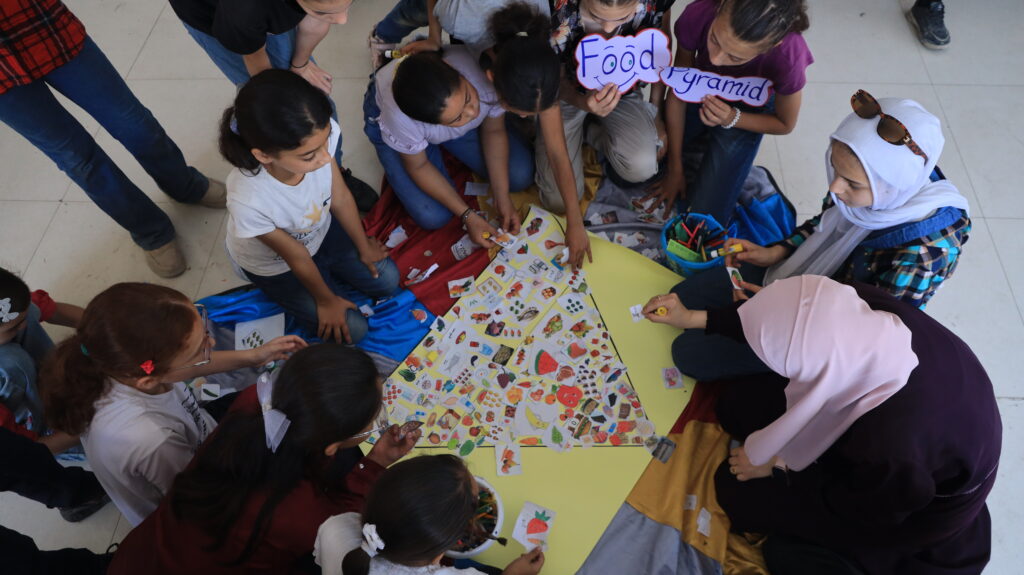
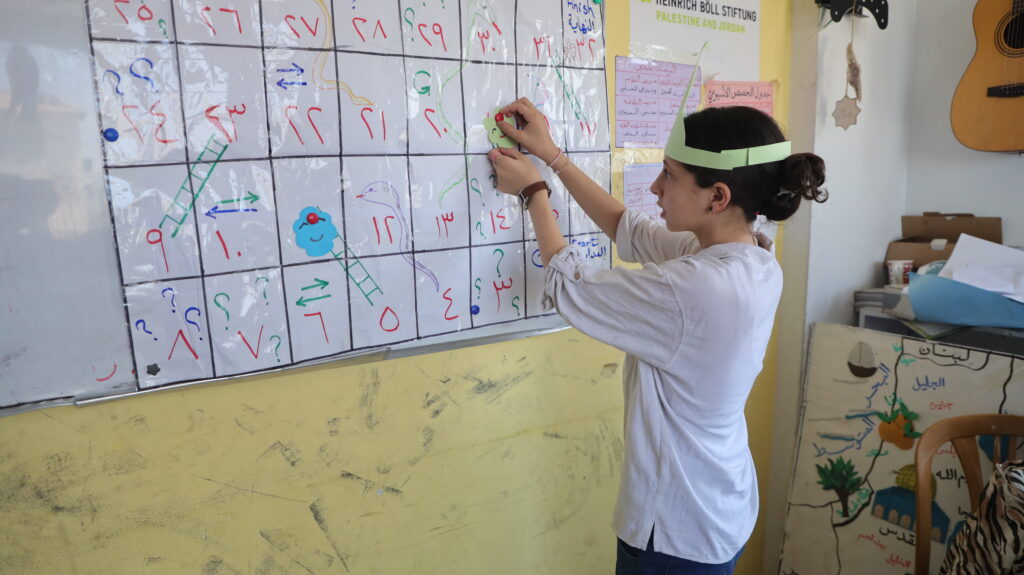
The curriculum includes basic subjects such as Arabic and mathematics, with support from the Humanitarian Fund for the Occupied Palestinian Territory, and subjects such as English and general science have been added through the efforts of the association, with the program receiving accreditation from the Ministry of Education.
However, education in times of war cannot be separated from the psychological effects, as many of the
children who enrolled in classes had been displaced several times and faced traumatic situations that left their mark on their behavior. Rawan continues, “Some students would curse at each other, while others could not sit still. They were filled with anger and fear because the war had stolen their childhood.”
To address this reality, the association enlisted the help of psychologists and social workers and provided two sessions of psychological support for each class per week, in addition to special sessions for students and parents as part of a comprehensive mental health program, believing that a child’s recovery begins with the family Rwand continues, “We began to notice a gradual difference, through the children’s calmness, the absence of swearing, and the beginning of healthy relationships with each other, which is indeed a real achievement.”
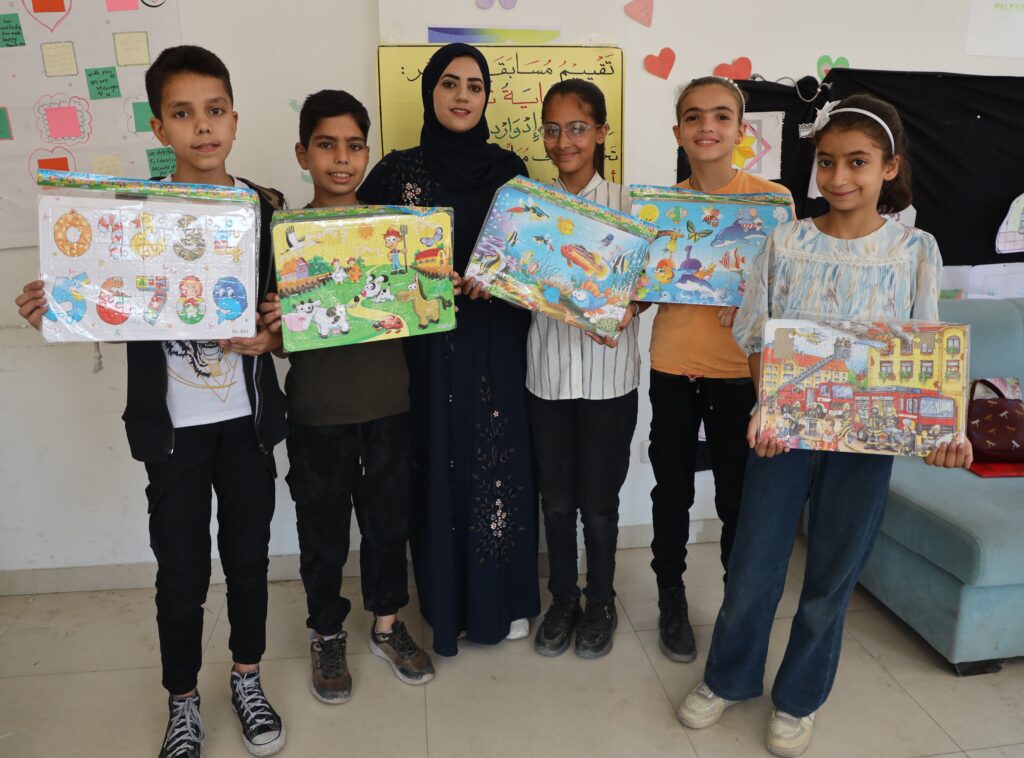
The association did not stop at education and psychological support, but also provided students with school supplies, winter clothes, books, and toys.
In early 2024, it partnered with the World Food Programme (WFP) to distribute high-quality biscuits, which were often the only breakfast for some students. Rwand concludes her story with a smile of hope (Today, students arrive at school early, asking for more lessons and time to draw. They don’t want to leave, as if clinging to the crumbs of life that were stolen from them).
Despite the surrounding destruction and the sounds of war that have not yet subsided, the Youth Vision Association’s initiative to educate children a living testament to the fact that investing in education is not a luxury but a necessity for survival.
The road may not be easy, but with those who insist on planting seeds in a land where everything has been burned, the seeds of hope remain capable of growing even in the most difficult circumstances.